|
|
EIS-FELA members welcome the Scottish Government’s announcement of an additional £70 million for colleges in the 2026-27 budget, although we now note it seems this is an additional £40million in resources only with £30m already earmarked in the budget for the Dunfermline campus of Fife College.
This signals a move in the right direction but is not enough to restore the damage caused by years of sustained underfunding, as set out in various reports into the sector including from Audit Scotland the Scottish Funding Council in 2025.
|
|
|
Members note the allocation is probably insufficient to take pressure off colleges to seek alternative income sources which has driven an increasing reliance on privatisation, outsourcing, and commercial activity, allowing public funds to leak out of the college sector.
Nonetheless, members look forward to an opportunity to work within the sector to ensure the money enhances quality learning and teaching as outlined in our recommendations from the Follow the Money report which highlights the cumulative impact of more than a decade of real-terms cuts on colleges, including staffing pressures, reduced provision, and growing financial instability across the sector.
|
|
|
EIS FELA Parliamentary Reception
|
|
|
|
|
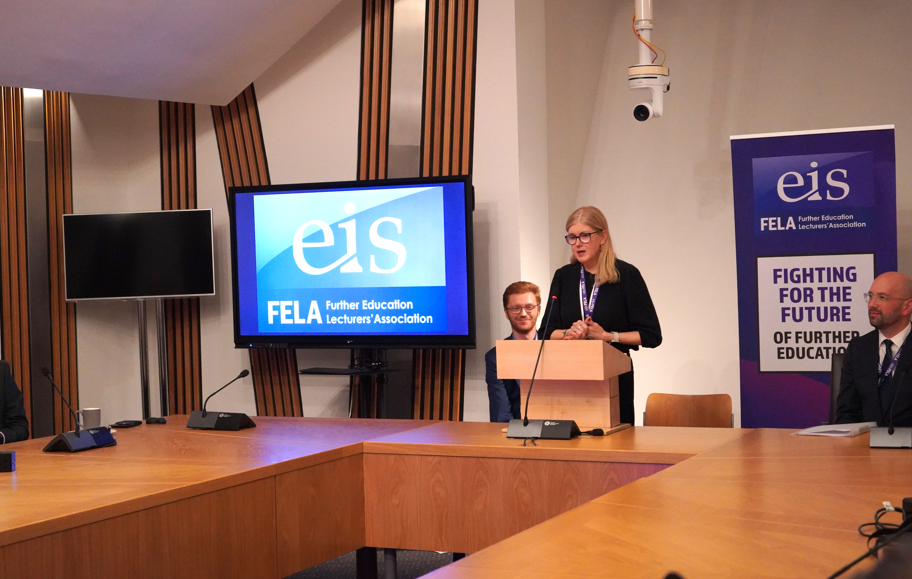
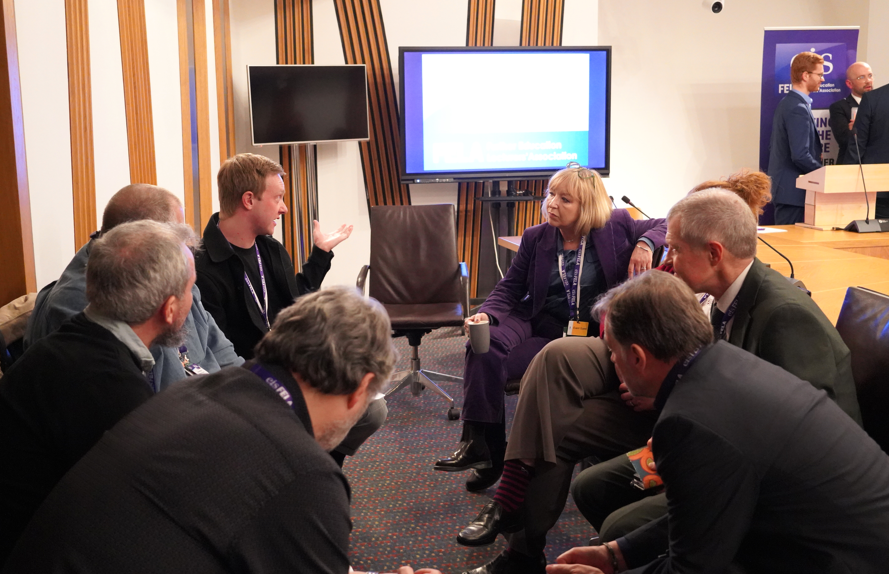
EIS-FELA members hosted a parliamentary reception on 13th January, the evening the Scottish Budget was announced, with the Minister of FE/HE in attendance and all opposition parties’ co-sponsoring. Members from UHI partner colleges, Forth Valley, Fife and Dundee & Angus colleges spoke to their particular local challenges and urged MSPs and guests in attendance to heed our warnings.
|
|
|
National rep, Pete Woods, said “This was a valuable and effective exercise in ensuring MSPs were exposed to the maximum number of our key issues as possible. It was great to see MSPs engaged in detailed conversations with reps. Your colleagues talked the ears off the politicians, they were brilliant! There was documentation produced outlining key issues at the Colleges and Reps took every opportunity to take photos and get their story across. Without doubt the MSPs were far better informed after this hour! Particular thanks to General Secretary, Andrea Bradley, for making such an impassioned defence of the sector and members; and Vice-President, Dr Thora Hands, for clearly outlining our concerns and recommendations from our report.”
|
|
|
Furthermore, after years of highlighting Principals’ unregulated pay settlements, it was announced that they would now be subject to the remit of the public sector pay remuneration group – a key recommendation from our Follow the Money report as they are currently the only Chief Execs in the Scottish public sector who are not covered by this national policy!
The 10% increase in funding (capital and resources) is welcomed alongside provisions passed in The Tertiary Education (Funding and Governance) (Scotland) Bill (TET) which passed through the Scottish Parliament on 20th January 2026. Whilst members continue to have reservations about the merging of SDS functions into the SFC in relation to apprenticeship and work-based learning provision, there are some key components of the legislation which we had lobbied for via submitting amendments to the Education, Children and Young People Committee at stage 2 and in discussions with the Minister. An outline of the ‘wins’ from our written and oral submissions are below, alongside other notable aspects of the legislation and some areas FELA would question.
|
|
|
Fundable education bodies to be defined as “post-16 fundable bodies” in line with other legislation which makes clear the main educational provision should come from colleges and universities, not private providers.
In section 15 of the Further and Higher Education (Scotland) Act 2005, SFC will now have the power to carry out efficiency studies which include consideration of the extent to which the needs and interests of staff are being met, including in relation to fair work principles (not just the financial bottom line or needs of students). SFC’s recommendations may be made public.
S20 is amended to allow SFC to have regard to the desirability of promoting fair work principles (as well as finances, student needs etc); and to the economic, social and environmental priorities of the Scottish Ministers.
The Minister announced at the FELA parliamentary reception on 13th January that the Fair Work principles will be defined as the 7 criteria of FWF (instead of previously two):
- Payment of at least the real Living Wage.
- Provide appropriate channels for effective workers’ voice, such as trade union recognition.
- Investment in workforce development.
- No inappropriate use of zero hours contracts.
- Action to tackle the gender pay gap and create a more diverse and inclusive workplace.
- Offer flexible and family friendly working practices for all.
- Oppose the use of fire and rehire practices.
Section 9H of the 2005 Act is amended in that SFC now must inform and consult TUs when making a payment to colleges/universities before making decisions which could significantly impact its provision, levels of staffing, or financial sustainability.
A review of the credit-based funding model from SFC will take place within 12 months.
National training programme providers and work-based learning providers will be subject to conditions of funding from the Scottish Ministers and/or the SFC, ensuring some financial scrutiny over them.
|
|
|
Other positive aspects of note of TET
|
|
|
Further conditions of funding: principles of governance which constitute good practice in relation to colleges or RSBs include operating in a way which is transparent and accountable; members of the governing bodies and senior officers must declare all conflicts of interests and keep a register of interests including family ties, paid consultancy work, IP, and shares; colleges must have a whistleblowing policy; and there must be reporting on the action taken to prevent gender based violence towards staff or students.
The SFC must secure the monitoring of financial sustainability of colleges and can ensure an independent external examination on the financial sustainability or financial governance with reporting to the Scottish Ministers.
The SFC may issue guidance on the identification of skills needs and skills planning in particular localities. This should help to focus provision on the needs of students and prospective students in Scotland.
National training programme providers and work-based learning providers will be subject to annual reports on performance by the SFC.
|
|
|
Ensuring a national funding strategy is published seems a good idea but section A1 sets out that Ministers should consult trade unions but only so far as those representing the interests of apprentices i.e. not those representing the interests of staff delivering education. We may fall under “other persons considered appropriate” to be consulted but it seems a bit of an (intentional?) oversight when fair work is being promoted.
Employers and training providers have been given wider scope to be consulted with in relation to the national funding strategy and apprenticeships, with a distinct apprenticeship committee, employers being given two seats on the SFC Board, and space available for work-based learning providers.
Trade unions have not been specifically mandated a seat on the SFC Board (outwith representing the staff of SFC or apprentices), instead “persons who appear to be representative of employees of any bodies or persons who receive payments from the Council for the purposes of securing the delivery of fundable further education, fundable higher education, Scottish apprenticeships or work-based learning” should be considered for a space on the Board.
|
|
|
|
|
The Forth Valley EIS-FELA branch has led a joint campaign alongside sister unions Unison and GMB to safeguard jobs at the college and to protect FE provision in Alloa.
They have arranged several public facing shows of support for the campus such as a public meeting which gathered cross party support and a demonstration outside Alloa Colleague with strong community backing.
A “wear purple for FE” day is planned for the 4th of February and a march has been organised for Saturday 21st February ahead of the Board’s meeting the following week to make a recommendation on Alloa campus.
All of these actions help keep the issue of funding for FE and the future of Alloa campus in the minds of members, politicians and the public.
|
|
|
|
|
Dundee and Angus EIS-FELA have led a dynamic campaign which has gathered the support of students, staff and members of the public through building support for a petition which gathered more than 8,000 signatures through engaging with staff and students in college, utilising local social media pages, and through publicity stunts like their community walk from the Abroath campus of Dundee and Angus College to the Gardyne campus.
|
|
|
A petition was considered by the Scottish Parliament's citizens’ participation committee at the behest of the EIS-FELA branch, calling for more funding for FE. The committte considered the petition in January 2026 noting the Scottish Government's engagement on funding.
|
|
|
The first deadline for GTCS registration passed on 31st December 2025 and 3,394 lecturers are now fully registered with 337 provisionally registered. NJNC Circular 02/24 sets out the timescales for registration depending on when you began employment in the sector and qualifications.
The next deadline is for lecturing staff who commenced employment in the sector between 1st January 2005 and 31st December 2013 inclusive and hold a TQFE; a GTC Scotland recognised primary or secondary teaching qualification gained in Scotland; or an equivalent reaching qualification gained outside of Scotland. They are required to hold full registration with GTC Scotland by 31st December 2026.
Please ensure you read the Circular in order to determine when you are required to be registered by as you may need to begin the application process now or try to ensure TQFE provision with your employer.
Further advice on GTCS registration, professional learning updates, and training will be sent to members within the next fortnight.
|
|
|
FELA upcoming training sessions
|
|
|
Training on the NWPA - Wednesday 18th February 4.00pm – 6.00pm – Teams (open to all FELA members)
This session will be ran by FELA National Reps and will cover different aspects of the NWPA with the facility to ask questions, the session will take place on Teams. (Part 1 of 2, you can attend either or both sessions)
Training on the NWPA - Wednesday 25th February 4.00pm – 6.00pm – Teams (open to all FELA members)
This session will be ran by FELA National Reps and will cover different aspects of the NWPA with the facility to ask questions, the session will take place on Teams.
(Part 2 of 2, you can attend either or both sessions)
TU reps on boards training – accounts etc, Friday 27th February 10.00am – 12.30pm, Glasgow (open to Trade Union and Staff reps on boards)
This session is for Trade Union Reps on College Boards and Staff Reps on College Boards, the session will look at College Accounts, the session will take place in person in the EIS Glasgow office.
TU reps on boards training – role play board meetings, Friday 27th February 1.30pm – 4.00pm, Glasgow (open to Trade Union and Staff reps on boards)
This session is for Trade Union Reps on College Boards and Staff Reps on College Boards, the session will look at roleplaying College Board meetings, the session will take place in person in the EIS Glasgow office.
Training for new branch officials, Friday 27th February 2.00pm – 3.30pm - Teams (please note this date was originally circulated as Friday 30th January) – please ensure all new branch representatives attend this session
This session is for all branch officials, in particular new branch officials, please encourage new branch officials to attend this session, the session will take place on Teams.
|
|
|
|